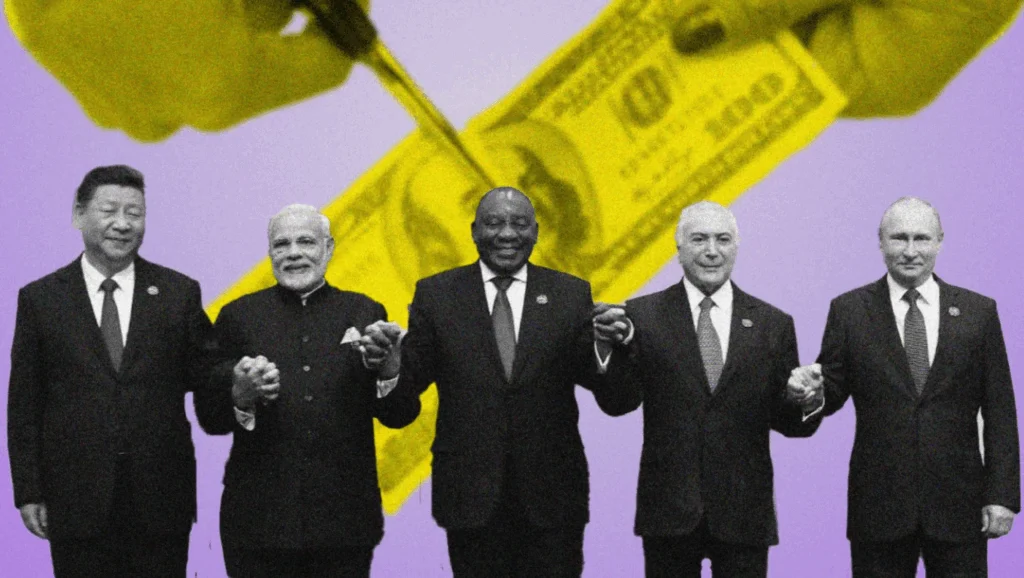

A New Challenger Appears: The BRICS “Unit” – A Gold-Backed Digital Currency for Global Trade
Think the world of money is set in stone? Think again. In a move that could shake the very foundations of global finance, the BRICS bloc has officially launched a pilot for a brand-new digital currency called “The Unit.” This isn’t a Bitcoin rival for your online shopping; it’s a strategic tool designed for one major purpose: to let powerful nations trade with each other without relying on the U.S. dollar.
The launch comes at a time when searches for “dollar debasement” – fears about the dollar’s long-term value – are hitting record highs. The BRICS nations, which now include Brazil, Russia, India, China, South Africa, Egypt, Ethiopia, Indonesia, Iran, and the United Arab Emirates, are offering what they see as a more stable alternative.
So, what exactly is this “Unit,” and could it really change the game? Let’s break it down.
Sponsor Break!

What Is The BRICS “Unit”?
Simply put, the Unit is a digital trade currency backed by real assets. It’s like a digital token that represents a specific basket of value, designed to be used for settling massive cross-border transactions between governments and central banks. Your average person won’t be buying groceries with it; this is built for the big leagues of international trade and finance.
Its core innovation is its backing. The value of each Unit is not based on faith in a single government but on a tangible mix:
- 40% is tied to physical gold, providing a classic, stable store of value.
- The remaining 60% is a basket of currencies from the five founding BRICS nations: the Brazilian Real, Chinese Yuan, Indian Rupee, Russian Ruble, and South African Rand.
This structure aims to offer a neutral, stable settlement option that reduces the need for all these countries to constantly buy and hold U.S. dollars for trade.
Why Create a New Trade Currency? The Push for “De-Dollarization”
For decades, the U.S. dollar has been the world’s default currency for international trade and reserves. This gives the United States significant financial and geopolitical influence. Many BRICS nations want to reduce this dependency, a process called “de-dollarization.”
Their motivations vary but often include:
- Avoiding Sanctions Risk: Countries like Russia and Iran face severe financial sanctions that limit their use of the dollar-based global system. The Unit offers a potential workaround.
- Reducing Costs and Volatility: Converting local currencies to dollars and back for trade adds cost and exposure to fluctuations in U.S. monetary policy.
- Building Financial Independence: The project is a major step toward creating a parallel financial architecture led by emerging economies.
How Does “The Unit” Actually Work?
The pilot project is being run by the International Research Institute for Advanced Systems (IRIAS). Here’s a look under the hood:
- It’s Built on Blockchain: The Unit operates on a permissioned blockchain (specifically, the Cardano network), which provides a transparent and secure ledger for all transactions and daily value calculations.
- Daily Value Adjustments: The value of the Unit isn’t fixed. It is recalculated every single day based on the current market prices of its gold and currency basket. This is all done automatically on the blockchain.
- An AI “CEO”: In a futuristic twist, the UNIT Foundation overseeing the project has appointed an Artificial Intelligence as its CEO. The idea is that an AI leader can operate without political bias or emotional influence, focusing purely on the system’s stability and rules.
- Pilot Phase: It’s crucial to remember this is still a research pilot. It has not yet been formally adopted by the BRICS central banks or their New Development Bank. It’s a working prototype to test the concept.
What Does This Mean for the Dollar and Gold?
The immediate impact on the average American or the global dollar system is minimal. The U.S. dollar’s dominance is deeply entrenched and won’t vanish overnight.
However, the long-term signal is powerful:
- For the Dollar: Every successful non-dollar trade corridor chips away at the dollar’s monopoly. If the Unit scales, it could slowly reduce global demand for dollars over decades.
- For Gold: This is potentially huge for gold. The Unit transforms gold from a passive reserve asset sitting in vaults into an active component of daily international trade. If the system grows, it could create sustained, structural demand for gold as BRICS nations need to acquire more to back new Units.
The Road Ahead: Can This Really Work?
The Unit faces massive hurdles before it can become a true dollar alternative.
- Political Coordination: Getting ten diverse nations with different economic policies and priorities to fully align is a monumental task.
- Scale and Trust: The pilot is tiny. Building the immense trust and liquidity needed for a global trade currency takes years, if not generations.
- Technical and Regulatory Harmony: Creating seamless connections between different national banking and payment systems is a complex technical and regulatory challenge.
For now, the BRICS Unit is a bold experiment. It proves that the search for dollar alternatives has moved from talk to tangible testing. Whether it becomes a footnote in financial history or the foundation of a new monetary system is a story that will unfold over the coming years.
FAQs About the BRICS “Unit”
Q: Is the Unit a cryptocurrency like Bitcoin?
A: Not really. While it uses blockchain technology, it is a permissioned, centralized digital currency created by a coalition of governments for specific official purposes. It’s not meant for public investment or decentralized use.
Q: Can I buy or invest in the BRICS Unit?
A: No. The Unit is not an investment vehicle for the public. It is designed as a settlement tool between governments and financial institutions.
Q: Will this replace the U.S. dollar?
A: Extremely unlikely in the short or even medium term. The dollar’s role is supported by the size of the U.S. economy, deep financial markets, and global trust built over a century. The Unit is a potential challenger in specific trade corridors, not a direct replacement.
Q: Does this mean BRICS countries are ditching their own currencies?
A: No. The Unit is not meant to replace the Brazilian Real, Chinese Yuan, or any other national money. It is intended to be a neutral third option for trade between them.
Q: Why is there an AI CEO?
A: The developers state that an AI leader can manage the currency’s rules without national bias, political pressure, or emotional decision-making, aiming for pure stability and neutrality—key traits for a tool meant to be trusted by multiple rival nations.