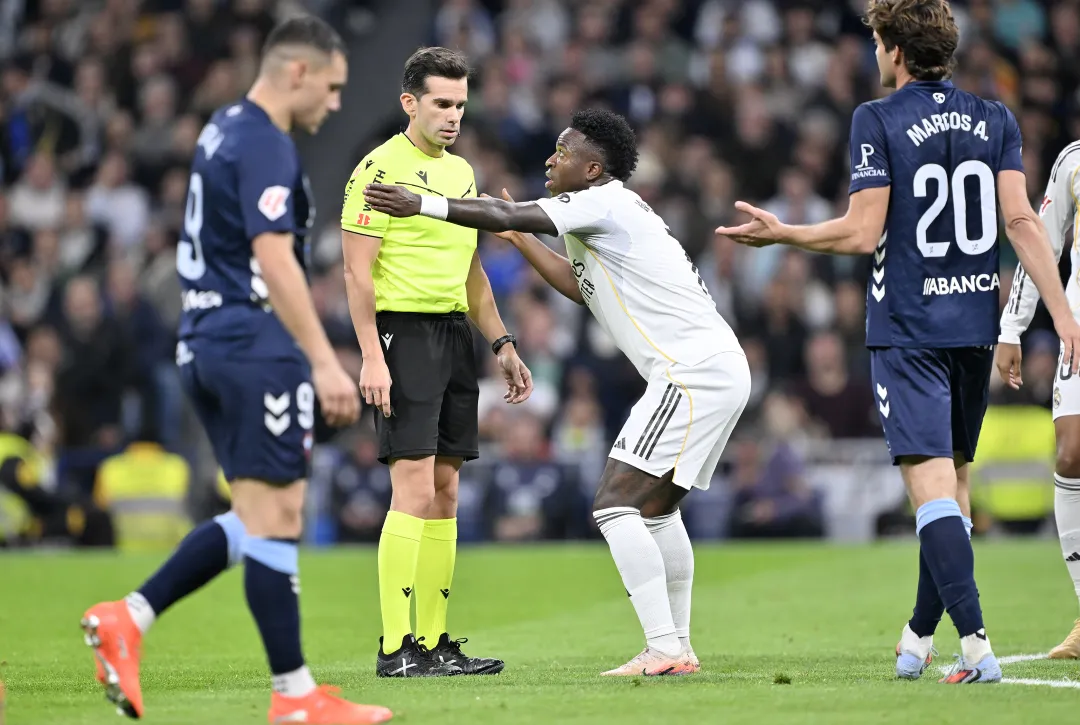

Hey there, football fan. Let’s talk about one of those nights. You know the kind—when a simple game of football erupts into something far more tense, emotional, and downright chaotic. That’s exactly what happened at the Santiago Bernabéu recently, and the referee’s official match report from Real Madrid’s 0-2 defeat to Celta Vigo reads more like a drama script than a sporting summary.
The document paints a crystal-clear picture of a night where frustration wasn’t just felt by the fans in the stands; it boiled over from the pitch, to the bench, and right down into the tunnel after the final whistle. If you thought you saw a messy game, the official notes confirm it was even more heated behind the scenes. Let’s walk through what really went down, piece by surprising piece.
The Spark: Bellingham’s Baffling Booking
The tone for a frustrating evening was set early with one of the strangest yellow cards you’re likely to see this season. It involved Jude Bellingham, Real Madrid’s superstar midfielder, and it’s a sequence that left everyone scratching their heads.
Here’s what happened: during play, Bellingham took an elbow to the head from Celta Vigo’s Borja Iglesias. It was a nasty blow that left him bleeding. The referee, Quintero González, didn’t deem the elbow worthy of a foul, but Bellingham clearly needed treatment. He left the pitch to get patched up, a common sight in any match.
Sponsor Break!

After being cleared by the medical team, Bellingham waited on the sideline to re-enter. He even received a nod from the fourth official—the standard signal that it’s okay to come back on. But the moment his foot touched the grass, the referee blew his whistle and brandished a yellow card. The reason listed in the report? Entering the field of play “without authorization.”
Think about that for a second. A player is forced off due to an unpunished foul, gets permission from an official to return, and is then booked for doing exactly that. It’s no wonder this bizarre moment became a symbol of the team’s growing sense of injustice. For the players and the coaching staff, it must have felt like they were playing against more than just the eleven men in Celta shirts.
The Fire Grows: A Red Card and Rising Temperatures
If Bellingham’s booking was a spark, what happened to Fran García in the second half poured gasoline on the fire. The young defender had a minute to forget—a disastrous 60 seconds that ultimately decided the match’s fate.
García, already on a yellow card, committed two reckless, lunging tackles in quick succession. The first was a wild challenge that earned him his second yellow. Before the team could even process that dismissal, he flew into another tackle. The referee didn’t hesitate, pulling the red card directly from his pocket.
In the space of a single minute, Real Madrid went from chasing the game to facing it with only ten men. The uphill battle had just become a mountain climb. You could feel the desperation and anger swell in the stadium. The players knew their chances had just evaporated, and that frustration began to manifest in arguments with the officials.
Rodrygo, known for his cheerful demeanor, was booked for shouting at the assistant referee. The ever-professional Federico Valverde received a yellow for dissent. The dam of discipline had well and truly burst.
The Explosion: Bench Clearing and Tunnel Tensions
When a team feels wronged, that emotion isn’t confined to the 22 players between the lines. It spreads like wildfire, and on this night, it consumed the substitutes’ bench and even the post-match hallway.
The most shocking detail in the entire report involves Endrick, the brilliant young Brazilian striker. He wasn’t playing, but he found himself at the center of the storm. According to the referee’s notes, Endrick leapt from the bench and sprinted toward the fourth official, shouting aggressively. Real Madrid coaches had to physically restrain him from getting any closer. His passion for his teammates crossed a line, and the referee deemed it serious enough to show a straight red card, sending him from the bench to the dressing room early.
But wait, it gets even more dramatic.
The final whistle didn’t end the conflict. As the teams and officials headed for the tunnel, Real Madrid’s veteran defender Dani Carvajal confronted the referee. The report includes his words verbatim, and they perfectly capture the bitter mood: “The level you play at, and then you’re crying in the press conference.” It was a stinging, personal critique questioning the referee’s competence and professionalism.
Even the normally composed manager, Xabi Alonso, wasn’t immune. He was shown a yellow card in the 73rd minute for persistent protests from his technical area. From star player to young substitute, from captain to manager—no one in white was holding back their feelings.
Reading Between the Lines: What This Report Really Tells Us
So, what do we make of this extraordinary document? A match report is supposed to be a dry, factual account. But this one tells a vivid story of a club that felt besieged by decisions that seemed, from their perspective, unjust, inconsistent, and costly.
The six yellow cards, two reds (plus Endrick’s), and the tunnel confrontation aren’t just a list of infractions. They are symptoms. They tell us that the players’ trust in the officiating had completely broken down. When Bellingham gets booked for following the rules, and a bloody foul goes unpunished, it creates a “them vs. us” mentality. Every subsequent call is viewed with suspicion and anger.
For Real Madrid, a club defined by its winning mentality, this kind of chaotic, emotionally charged defeat is a rare and painful event. The report doesn’t just record a loss; it documents a collective breakdown in composure, a night where passion tipped over into self-destruction. It will serve as a stark lesson for Xabi Alonso and his squad about controlling the controllable, even when nothing seems to be going their way.
For fans and neutrals, it’s a fascinating look at the high-pressure cooker of elite football, where millions are on the line and emotions are always just one bad decision away from boiling over. The Bernabéu has seen countless glorious nights, but this official report will forever chronicle one of its most furiously frustrating ones.
Your Real Madrid Match Report FAQ
Q1: Why was Jude Bellingham really given a yellow card?
The official reason listed was “entering the field of play without authorization.” The controversy stems from the fact he was treated for a bloody cut off the pitch and appeared to get permission from the fourth official to return. Many see it as a harsh and confusing application of the rule.
Q2: What did Fran García do to get sent off so quickly?
He was sent off for two bookable offenses in extremely quick succession. Already on a yellow, he made two reckless, lunging tackles within a minute. The second challenge was so bad the referee showed a straight red, meaning he didn’t even wait to give a second yellow.
Q3: What got Endrick, a substitute, a red card?
Endrick was dismissed from the bench. The report states he left the substitute area and ran aggressively towards the fourth official while shouting, and had to be held back by coaching staff. Referees take this very seriously as it’s a direct challenge to their authority from outside the field of play.
Q4: What’s the big deal about what Carvajal said in the tunnel?
The phrase itself—“The level you play at, and then you’re crying in the press conference”—is a deeply personal criticism. It suggests the referee’s performance was poor and accuses him of later playing the victim in media comments. Having such a direct insult recorded in the official report is highly unusual and escalates the conflict.
Q5: Did the referee miss a foul on Bellingham before all this started?
Yes, that’s the root of much frustration. Bellingham was bleeding from a clash with Borja Iglesias, which the referee did not call as a foul. So, the sequence began with an unpunished elbow and ended with Bellingham being punished for trying to return after getting patched up.
Q6: How rare is it for a manager like Xabi Alonso to get booked?
While not extremely rare, it’s a sign of a particularly heated game. Managers get cautioned for leaving their technical area or for persistent, aggressive protesting. Alonso’s yellow card in the 73rd minute shows that the frustration had spread to the very top of the team’s staff.